In the design practice, it seems that impregnating everything with fun and joy is an unwritten rule. Digital designers, not having control of all the sensorial corners of the experience—such as marketing and branding—want to inject their projects with triggers of positive reactions hoping to make product interactions as gratifying as possible.
It makes sense to a certain point because designers want users to feel connected with the product's offering. That seems like the bare-bones description of the profession: To make transactions pleasant. To do that, designers sometimes tap into the non-conscious areas of Emotional design: The Visceral and the Behavioural.
If you are not familiar with the levels of Emotional Design, this article from Interaction Design Foundation will bring you up to speed.
However, "emotional exhaustion" is a thing that feels very real and close today. With so many things happening in our world, it makes sense to stop caring about the things that have little to no real consequence in our lives. We start rejecting what we might detect as shallow attempts at being charming.
If you as a designer really care about both sides of these transactions, and if—as Emotional design intends—you want users to react with positive feelings to the experiences you create, you should start prioritizing other things in your products, apart from that good ol' fun and joy. Here is why.

Life is (mostly) boring
I believe designers as a group share some ideas of what a good project is. We are enamoured with the idea of building addictive products, influencing big audiences, and impacting many lives. Creating engaging experiences that aim to ignite every pleasure center in the brain and sequestering the user's attention. Doing extensive research to find out what fires up our consumer base. We want to hit, and we want to do it hard, not only for the sake of the consumers but for our own professional (and personal) satisfaction.
It is perfectly fine to have goals to work for specific brands or doing certain types of projects, as long as we understand that is a limited dimension of what success can be. Nevertheless, those are egotistical expectations. That line of thinking is unrealistic because the market space for those over-the-top experiences is limited. Besides, none of those characteristics directly reflect the usefulness and usability of a product, but only personal success as designers.

I, in a moment of my career, was also fixated with these personal expectations. I wanted every interface to be akin to a religious experience, a journey to discover, or a work of art. Probably it was Steve Krug's "Don't make me think" that made me realize I was doing that only for my personal enjoyment, instead of doing the job I was being paid for.
Moreover, the market for exciting experiences is limited because life is not a trip of endless delight (unless you are into some strong stuff). Most of our daily interactions with products are made to be invisible, not outstanding events. Most things in our day-to-day lives simply do not deserve that type of exceptional energy; that would be exhausting for everybody that is not a euphoric golden retriever. Imagine every service we engage during the day impacting us with that hard-hitting mood.
And let us not forget that boring things are where good design is really needed—those menial and annoying tasks. The stuff you want to do fast and with as little overhead possible. That is something that alone and without the help of any gimmick might produce a positive reaction. Besides, the most crucial experiences of "normal" life usually require a level of solemnity. Imagine being distracted with unnecessary stuff while filing your taxes.
There is a difference between understanding your user's likes and your user's needs in a particular situation. An attractive experience that is not entirely focused on solving problems is a superficial experience, no matter how enjoyable. It is like going to school just to chat and play. It is possible that we all wanted that at some point... and it would have been a disaster for everybody.
Stop trying to make fun happen
After understanding the user's context, it is valid to ask ourselves how a little bit of fun can affect an experience. Being nice never hurt anybody. But think in the function of how unnecessary things can bloat your experience and—in the worst-case scenario—how forcing attitudes can backfire.
It is naive to think that we need to transform every boring and tedious activity into a fun one to be successful. The same happens when you try to turn every business relationship into an emotional one. Designers who put their love into those experiences might find their efforts a sincere attempt to connect with the users. Nevertheless, consumers are dealing with their busy lives, and very possible with other products trying to pull the same distracting stuff.
If a user has to face a tedious activity, the obvious thing should be to do it as fast and efficiently as possible, not trying to rewire their brains or make it look playful to love it. These unnecessary attempts to be engaging can have many faces and might be hard to spot because they make sense in other contexts.
It can be as simple as using novelty interactions that feel like speed-bumps when you use them often, animations that become repetitive (or last too long), or text copy that is hard to understand because it is trying too hard to be witty. They are out-of-place devices, placed there only to distract and try to make a good impression. Superficial attempts to engage the layer of Visceral design that does not fit—or probably even hurt the experience.
Sometimes the attempts to transform a product might go deeper than a bad paint job, and a great example is Gamification. Creating game-like rewards seemed like a good idea at first. After all, we do not play video games with a purpose; we do it because we enjoy the feeling of virtual achievements. Today, using Gamification to encourage things we actually need to do more, like chores or exercise, is a good idea—probably not enough by itself—but it makes sense to celebrate an actual accomplishment. Badges that recognize tasks that are going to be done one way or the other or as a manipulating tool to try to spend unnecessary time in your experience are inconsequential at best. Virtual achievements make sense when you are invested in a video game's complex and emotionally charged narrative. Even with them, it is pretty easy to go irrelevant. Badges end up feeling like participatory trophies or like a disappointing end to a menial task when we build emotional experiences based on them, expecting that the dopamine fix will be there forever.
These superficial experiences are the design equivalent of making vegetables or math fun.

The final tier of hit-and-miss attempts of being superficially emotional goes beyond the reach of most Experience designers. When the brand does not reflect the reality of the product and pretends to be something that is not, like brands claiming to be environmentally conscious while shipping their products with unnecessary and wasteful packaging.
The dynamics between branding and product are interesting, to say the least. People may argue that it is impossible to reach the conscious levels of Emotional design by the interactions alone. Sometimes a brand is so strong that it will give leeway to a sub-par experience. But that might be a topic for another time.
More than a feeling
I just mentioned that a product alone probably cannot engage with the higher elements of Emotional design—a.k.a. Reflective design—because values and aspirations can only be delivered using other communication mediums like the ones used for marketing and advertising. I do not think that it is true today, with product ecosystems becoming so complex and user interfaces taking such an important place in everyday life... but it is more complicated than that. The generations that engage with digital products the most today, actively check if their tools align with their values and ideals. Younger people are more conscious about what they consume, and it is also now easier than ever to be informed (and misinformed too). They want to be responsible consumers even though the whole idea is sometimes unreachable or contradictory. They will not wait for a product to reveal their own set of values. This means that engagement with Emotional design might not be an option—it will happen whatever wanted or not by its creators—and the responses from users are more complex, not merely positive or negative.
In this context, superficial experiences are bound to lose. Whatever the emotion you expect to trigger, your users will make you accountable for it. If you throw a weak attempt to reach the emotional side of your users, they—more often than not—will recognize it as it is and react negatively to it.
However, one positive response should be the first objective of any transaction: Trust.
Trust is actionable, and it has meaning on many levels. Trust cannot be randomly bolted like fun because it is deeply engrained in how a product works. It has universal value, even though are different ways to reach it. Every single day it is more and more important for products to reflect trust. That is why today, every hot topic in the tech business leads to a conversation about it, from advertising to artificial intelligence. And like happens with most relationships—human, animal or commercial—you need to build trust to create a strong relationship.
Even fun services need to do this at the most basic levels of their offering. A good example is that popular streaming service that is gaining the reputation of cancelling tv shows left and right, leaving its users second-guessing themselves if it makes sense to invest their time into narratives that probably will never reach a conclusion.
Trust has many faces, from generating the confidence that an interface is clear enough to not double-check every selection; to structuring a product that does not feel that will go belly flop at any minute. Even bad front-end can erode trust! If your product cannot align some visual elements properly... imagine how sloppy the back-end security must be. Every level of Emotional Design needs to engage trust differently!
Dopamine is a gateway drug
I decided to write this article because when browsing that popular social network for business, somebody was advertising a webinar to teach designers how to "burn their products into their users' retinas." That sounded scary, but I am sure that is not a strange sight; after all, this is one of the best-selling books about the design of experiences:
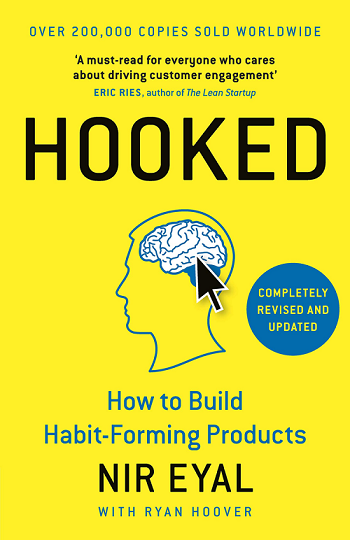
We now have built thousands of products wanting to rewire consumer's brains at the same time. They all want to develop deep relationships and require complete attention. They do not expect a positive reaction but a piece of people's lives. If it was uncomfortable to think about a world where every experience wants to bring you ecstasy, just think about the scenario where every service out there wants a place in your brain.
It seems that creating addictive experiences became the absolute endgame of the UX practice, and Emotional Design was the weapon of choice. It is not just about recognition and being top-of-mind. It demands more, constant attention. It is about deep engagement, hooking users, and building habits around a product. This is not the fault of designers wanting to create exciting products but—for the most part—of business models built on blind growth and sometimes unethical practices. We designers were only doing the job that we were told, not caring too much about its impact.
This might feel overwhelming. I started the article with advice to be chill with your users and ended up talking about brainwashing. But one is not far from the other. They are just different results of an unempathetic drive to play with the emotional responses of users. Sometimes you miss the target and lose customers, and sometimes you irresponsibly hit the bullseye and end up with a product that makes users depressed.
The drive to Design for Addiction has been toned down recently. It did not feel it went away, but we put it under the rug and never speak out loud again because we know it is terrible. We rebranded it, fused it with other strategies, and sent a few practices to the island of Dark Patterns to make us feel we were doing something right. Some words are still remnant that we never left the idea of wanting people to depend on what we create. Did you honestly felt awkward when I used expressions like "building addictive products" or "sequestering the user's attention" in the first paragraph of "Life is (mostly) boring"?

It was hard to find critiques on this topic in preparation for writing this post, even though the conversation about it has been out there for many years and in many different forms. We know there is a problem, but we do not assume we are part of it. I had to end up on this depressing note because it feels that we have been slow to realize how much responsibility we have with our users. It is silly to declare a project successful if your boss loves it, but it is an awful thing that nobody uses. So, why should we consider a success if a project brings money but impacts users negatively?
Maybe it is not enough to be empathetic.